Allkira, energy infrastructure for AI compute: off-grid, zero combustion, minimal water
Allkira means bright. We're building the energy infrastructure for Australia's AI future.
Allkira develops off-grid, renewables-powered AI campuses across Australia. Our integrated architecture brings energy and compute infrastructure together, with each design configured around the workload, scale and operating requirements of individual neocloud providers.
The problem
AI demand is accelerating. The infrastructure behind it is not.
Australia's data-centre electricity demand is projected to grow by around 25% a year to 2030. At the same time, large projects must compete for grid capacity, navigate multi-stage connection processes and secure water, land and community support.
The result is an infrastructure gap: demand for compute is arriving faster than the systems needed to serve it responsibly.
Speed
Connections measured in years
Large data-centre grid connections currently target approximately two years from application to energisation. All of this is contingent on the wider development programme being accepted by the community.
Capacity
Demand is outrunning available infrastructure
At March 2026, 5.4 GW of large data-centre load was already progressing through the NEM transmission connection process.
Environment
Every megawatt carries a footprint
Grid-powered growth can add carbon emissions, while conventional cooling can place concentrated demand on local water systems. All of this must be done in conjunction with Australia's goal of net zero.
Communities
Growth must earn social licence
Energy costs, water use, noise, backup generation and industrial development near homes can shift the burden of digital growth onto host communities.
The challenge is not whether Australia should build AI infrastructure. It is whether we can build it fast enough, cleanly enough and with communities, not at their expense.
What Allkira is
Purpose-built energy architecture for neoscaler workloads.
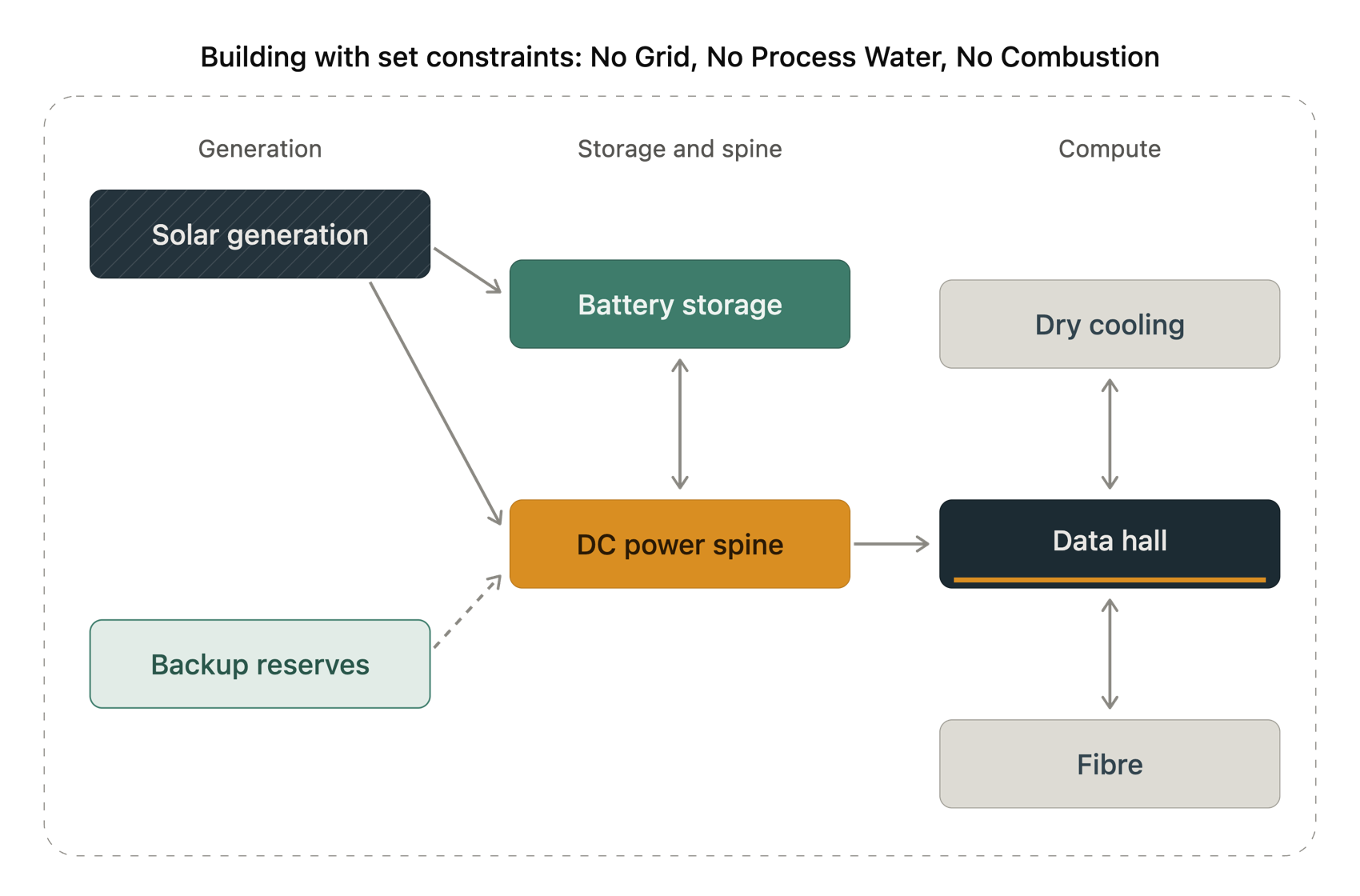
Allkira develops energy solutions for neoscaler workloads, locating and configuring each design to accelerate development and deploy capital efficiently. Each solution integrates a tailored mix of renewable generation, battery storage and dry cooling. The outcome is zero connection to the grid, net-zero operational emissions and no process-water use.
Integrated architecture
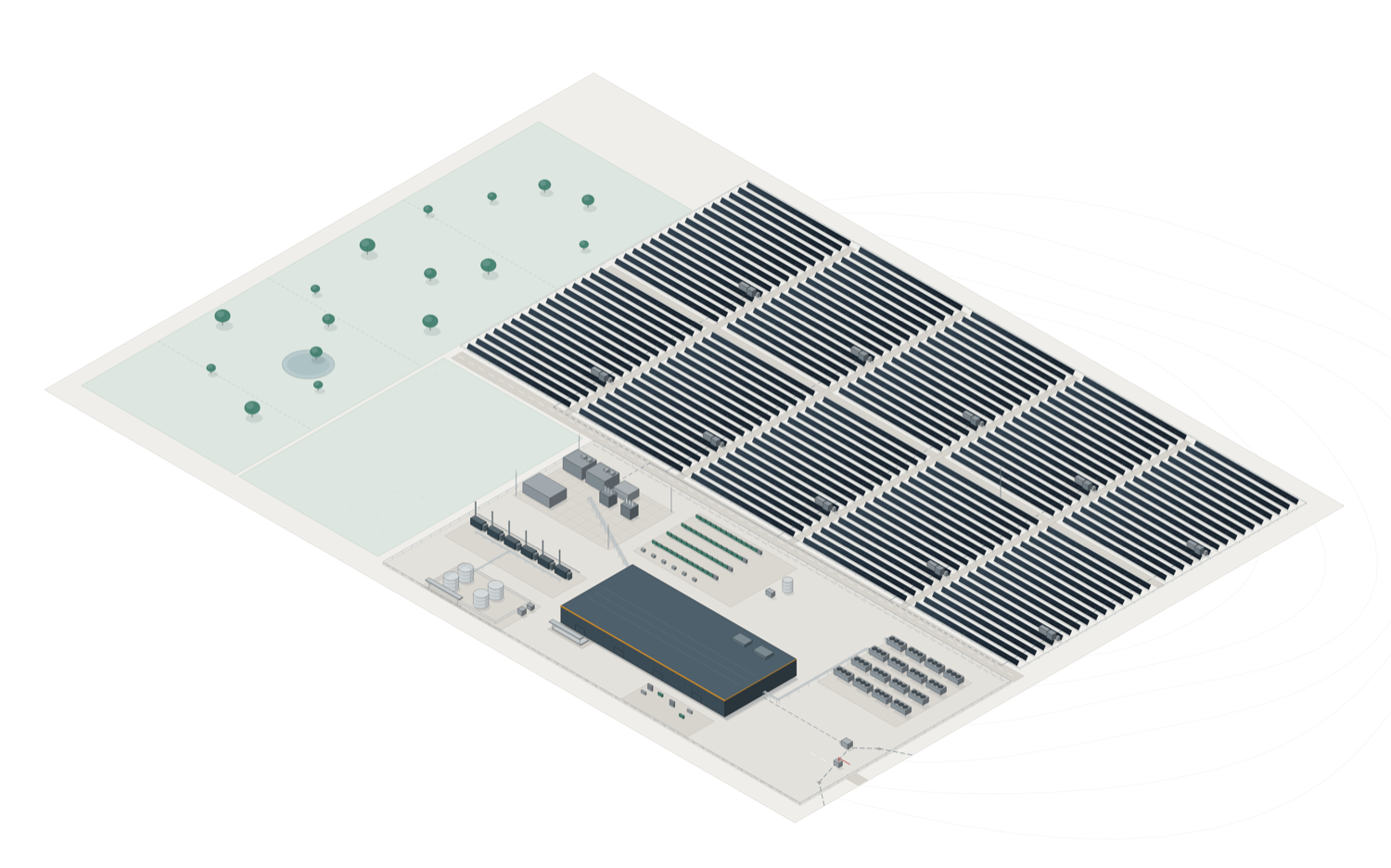
In the pipeline · Reference architecture
- ModelOff-grid
- BackupIn validation
- CoolingZero process water
- Reference regionNSW Orana REZ
Indicative reference design. This is not a secured, approved or financed project.
The model
Two models, one integrated system.
Two related but distinct ideas: how each campus is engineered, and how neoscalers buy the capacity it produces.
01 · Architectural model
Engineered as one system.
Allkira develops each campus as a single energy and compute system. Renewable generation, grid-forming battery storage, DC-optimised power delivery, direct-to-chip liquid cooling, dry heat rejection, fibre and compute infrastructure are designed together around each neoscaler's workload and service requirements.
02 · Business model
Contracted as one capacity.
Allkira designs and develops the energy solution while co-developing the data hall with the tenant, creating an integrated infrastructure system from generation through to compute. Neoscalers contract for the energy and infrastructure capacity they need, rather than procuring each subsystem separately. A common architectural philosophy supports multiple customer-specific designs, creating a repeatable platform without making every campus identical.
Partners
Building the infrastructure behind Australia's AI future.
Founded by Will Fowler and Matt Rimbo, Allkira designs integrated energy solutions and co-develops data hall infrastructure for neoscaler workloads across Australia.
Tell us what you are working to bring online.
Start a conversationAllkira white paper
The architecture, purpose and principles behind Allkira.
The Allkira white paper explains why energy and compute should be developed together. It sets out our vision and mission, introduces the people behind the company, describes the architectural and business model, examines the core subsystems and defines the principles guiding how each design is developed.
The Constraint Has Moved
Strip a computer processor down to its essence and you find a direct current machine: DC voltage, modulated through billions of logic gates, orchestrating stored charge into digital information. Each generation of silicon shrinks the logic and packs it denser, and every gain in density is a gain in power demand. This simple physical relationship, smaller transistors and greater power, is the engine underneath the global AI buildout.
That engine has now outgrown the world’s electricity grids, and Australia is racing to catch up.
Alternating current earned its place in the twentieth century. It made transmission, rotary machinery, and household safety practical. But the energy systems of the twenty first century are natively direct current.
Solar panels generate DC. Lithium batteries store DC. Chips consume DC. Yet every time one of these connects to the grid, a converter stands in between: inverters and transformers for solar farms, AC to DC chargers for electric vehicles, power supplies stepping grid power down to the low voltages chips demand. Every conversion stage adds cost, sheds energy as heat, and introduces another point of failure.
Design a localized system from first principles, where energy is generated and consumed on the same site, and the case for AC disappears entirely. Every component is already DC. This paper sets out Allkira’s approach to generating, storing, distributing, and reliably consuming energy for the modern datacenter.
Powering a Modern Datacenter
Grid capacity in Australia is tightening fast. By mid 2026, the National Electricity Market’s transmission connection queue held 5.4 gigawatts of large datacenter projects, with big connections running roughly two years from application to energisation, and the AEMC now drafting stricter technical standards for datacenter loads. At the same time, AEMO’s draft 2026 Integrated System Plan shows every major transmission project slipping, the construction peak pushed out from 2028 to 2030, and network costs surging. Waiting for the grid is no longer a strategy. Generation must be built alongside the datacenter, and if you’re disciplined about it, on the same site.
Many builders reach for natural gas. In Australia, that bet looks increasingly fragile: the ACCC projects structural shortfalls in the east coast gas market from 2028, and the southern states already lean on Queensland surplus and storage to get through winter. Tightening supply means rising and unpredictable prices.
Solar tells the opposite story. CSIRO’s latest GenCost report again ranks solar PV as Australia’s cheapest source of electricity out to 2050, and this continent has some of the best solar resource on Earth. The catch has always been firming: storage to turn daylight into round the clock power. But where fuel costs climb, solar and battery costs keep falling, year after year.
Allkira’s view is that solar paired with battery storage has crossed a decisive threshold of cost and scale, taking first place for cheap, stable, high power computing. It carries no fuel bill, no exposure to commodity swings, minimal moving parts, and no combustion.
Just as importantly, these technologies unlock a fully DC distribution architecture. That shift strips out the conversion stages that bleed efficiency, erode reliability, and inflate cost. With no grid connection, there is simply no reason to route power through AC. Build a solar and battery system from conventional grid tied components and you get an architecture with six or more conversion stages. Each stage can consume up to 20% of the energy passing through it, and the waste emerges as heat, which itself must be cooled, consuming yet more energy. A vicious cycle.
The Allkira Grid
Allkira’s model runs direct current end to end: generation, storage, and consumption in one unbroken DC chain. In its simplest form, energy cascades from the highest voltage at the PV array down to the lowest voltage at the load.
Fewer components chained together means less cost, less loss, less heat. Fewer parts means fewer critical links, and higher reliability. With only two conversion stages, losses can fall as low as 2% per stage.
Backup Energy
Every serious datacenter needs a backstop, and the conventional answer is a hall of diesel or gas generators. Allkira’s thesis is that combustion has no place on site. The Allkira grid delivers resilience through energy depth and redundancy instead: a solar array deliberately oversized against the load, distributed BESS modules holding deep reserves spanning many hours, and a modular architecture in which no single failure can take down the system. Extended low sun periods are engineered for statistically, sized into the array and storage from the outset, rather than papered over with fuel. The result is backup that never needs refuelling, never needs an emissions permit, and is tested continuously by daily operation rather than monthly generator runs.
Surge Capacity
A traditional AC power system holds almost no latent energy. Every swing in load must travel upstream to the generator, and quickly. AI training workloads make this brutal: minor fluctuations under 10% of system capacity are easily absorbed, but they are punctuated by swings exceeding 50% of capacity in a couple of seconds. For a conventional AC grid, those swings are a serious threat. AEMO has flagged datacenter load volatility as a system security risk in the NEM.
Even where the local power supplies feeding the AI nodes are specified for rapid transients, the grid and generation behind them rarely are. Large generation plant is heavy with inertia, slow to ramp, and often dependent on manual coordination to stay clear of blackout conditions.
Connect the compute directly to a source with near instant transient response, and the problem dissolves. Ramps from 10% to 50%, even 5% to 95%, become trivial. A battery bank sized for an 18 hour discharge window carries a discharge rating vastly beyond any surge the load can produce: a single 175Ah, 350V pack rated for 3C continuous discharge can deliver 184kW, against an 18 hour discharge load of just 3.4kW. That is roughly 5,400% of headroom. Surge demand simply stops being a design constraint.
Conclusion
AI has outrun the traditional grid, and the answer is sovereign, on site energy. By abandoning legacy AC infrastructure for an end to end DC architecture, Allkira strips out the conversion stages that turn as much as 30% of generated energy into waste heat, cutting losses to roughly 4%. By replacing monolithic plant and combustion backup with deep, distributed battery storage, it swaps single points of failure for inherent redundancy, and absorbs surge loads that would destabilise a conventional grid. Generating and consuming DC power in one place, with zero combustion, is how Australia powers the next generation of high performance computing.
© Allkira · The Constraint Has Moved · July 2026